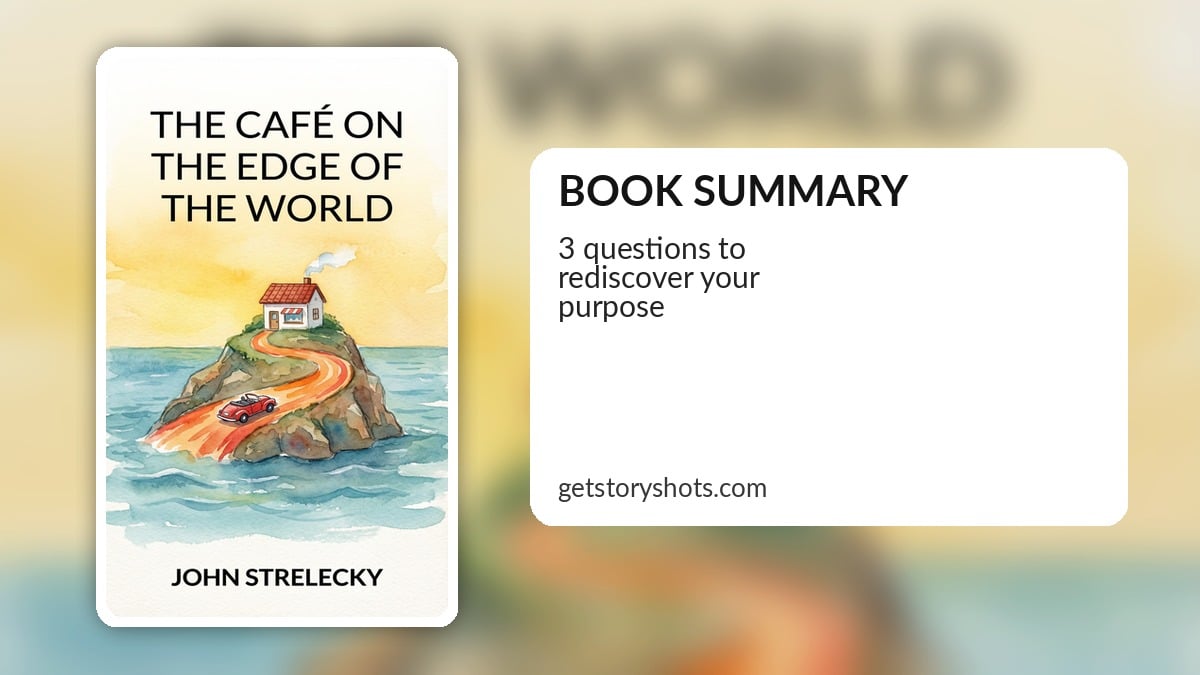
The Café on the Edge of the World Summary – 3 Questions to Rediscover Purpose
Ever feel like you’re running on autopilot, stuck in a life that looks successful but feels empty?
Introduction
This Cafe on the Edge of the World summary explores John Strelecky’s transformative parable about a man who stumbles into a mysterious diner and discovers three questions that change everything. Published in 2006, The Café on the Edge of the World has sold millions of copies worldwide and sparked a global conversation about purpose, meaning, and authentic living.
John is exhausted, taking a wrong turn with no cell signal, when he spots a small café in the middle of nowhere. On the menu are three uncomfortably personal questions: Why are you here? Do you fear death? Are you fulfilled? What begins as a simple meal becomes an existential recalibration—a chance to examine whether he’s living his life or just going through the motions.
The book is a quick read (under 100 pages), but its impact lingers. Through conversations with Casey the waitress, Mike the cook, and Anne—a woman who’s already answered the questions—John learns about the concept of Purpose for Existing (PFE) and discovers that most people spend their lives avoiding the very questions that could set them free.
If you’ve ever wondered whether there’s more to life than checking boxes and meeting expectations, this cafe on the edge of the world summary will show you how three simple questions can become your compass for a more intentional, fulfilling life.
Who The Café on the Edge of the World is For
This book is for anyone who feels stuck on autopilot—going through the motions of a “successful” life but feeling profoundly hollow inside. It’s for high-achievers who’ve climbed the ladder only to realize it’s leaning against the wrong wall. It’s for parents who’ve spent years caring for everyone else and forgotten what makes them feel alive. It’s for young adults standing at a crossroads, wondering which path leads to a life they’ll actually want to live. And it’s for anyone who’s ever asked, “Is this all there is?” and suspected the answer might be no.
If you’re ready to stop postponing your real life and start living with intention, this book offers a simple but powerful framework to help you find your way.
About the Author
John Strelecky is a bestselling author, speaker, and advocate for intentional living. After leaving a successful corporate career, he dedicated his life to helping people discover their purpose and design lives around what truly matters. His books, including The Big Five for Life and Return to the Café on the Edge of the World, have been translated into over 40 languages and have inspired millions of readers worldwide.
Strelecky’s writing is deceptively simple—short, accessible, and conversational—but it tackles profound questions about meaning, mortality, and what it means to live a life that matters. His work has resonated with readers across cultures because it speaks to a universal human longing: the desire to live authentically and without regret.
TL;DR
| Key Insight | What It Means |
|---|---|
| The Three Questions | Why are you here? Do you fear death? Are you fulfilled? These questions force you to examine whether you’re living intentionally or on autopilot. |
| Purpose for Existing (PFE) | Your PFE is your reason for being—the unique contribution only you can make. It’s your internal compass for every decision. |
| The Green Arrow | Activities that align with your PFE are “green arrows”—they energize you and move you toward your purpose. |
| The 7-Day Experiment | Commit 30 minutes daily for one week to an activity that aligns with your PFE. Prove to yourself you can choose. |
| Living Without Regret | Most people regret what they didn’t do, not what they did. The café’s questions help you avoid that fate. |
StoryShot #1: You’re Living on Autopilot (And You Know It)
John doesn’t end up at the café by accident. He’s exhausted, overworked, and running on fumes—physically and emotionally. He takes a wrong turn, his phone has no signal, and suddenly he’s in the middle of nowhere. This isn’t just bad luck. It’s a metaphor for how most of us live: disconnected, lost, and too busy to notice we’ve veered off course.
The café represents a rare moment of stillness—a chance to stop reacting and start reflecting. John’s first instinct is to get back on the road, back to the grind. But something about the place makes him stay. Maybe it’s curiosity. Maybe it’s exhaustion. Or maybe, deep down, he knows he needs to answer the questions on the menu.
This is autopilot. You’re not lazy or unmotivated. You’re just reacting to life instead of choosing it. You do what’s expected. You take the easy path. But you never ask yourself: Is this really what I want?
In practice: Notice when you’re operating on autopilot. Are you scrolling through your phone without thinking? Saying “yes” to commitments you don’t care about? Going through the motions at work? Autopilot behavior is efficient, but it’s also dangerous—it keeps you stuck in patterns that no longer serve you.
What aspects of your life are you living on autopilot right now?
StoryShot #2: The Three Questions That Change Everything
On the café’s menu, alongside the burgers and fries, are three questions: Why are you here? Do you fear death? Are you fulfilled? These aren’t small talk. They’re existential challenges designed to force you to examine your life with brutal honesty.
Most people spend their entire lives avoiding these questions. They’re uncomfortable. They require you to admit that maybe—just maybe—you’re not living the life you want. But avoiding them doesn’t make them go away. It just means you’ll reach the end of your life without ever answering them.
John is rattled. He doesn’t have good answers. He’s never really thought about why he’s here or what would make him feel fulfilled. He’s been too busy chasing success to ask whether success is even what he wants.
In practice: Set aside 30 minutes this week to answer the three questions. Write them down. Don’t censor yourself. Don’t try to sound impressive. Just be honest. If you don’t have answers yet, that’s okay. The point is to start asking.
StoryShot #3: Your Purpose for Existing (PFE) Is Your Compass
Casey, the waitress, introduces John to the concept of Purpose for Existing (PFE)—the reason you’re here, the unique contribution only you can make. Your PFE isn’t a job title or a role. It’s deeper than that. It’s the thing that makes you feel most alive, most yourself.
Anne, a woman John meets at the café, has already figured out her PFE: to inspire people to see the beauty in everyday moments. Everything she does—her work, her relationships, her hobbies—flows from that purpose. She doesn’t waste time on things that don’t align with it.
John realizes he doesn’t have a PFE. Or if he does, he’s ignored it for so long he’s forgotten what it is. He’s been living according to other people’s expectations—his parents, his boss, society. But none of that has anything to do with his purpose.
In practice: Ask yourself: What activities make me lose track of time? What do people come to me for? What would I do even if no one paid me? Your PFE is often hiding in plain sight, in the things you do naturally and joyfully.
StoryShot #4: Most People Die Without Ever Living
Mike, the cook, shares a hard truth: most people reach the end of their lives and realize they never really lived. They spent decades doing what they were “supposed” to do, and they died with their dreams still inside them. They feared death not because they were afraid of dying, but because they were afraid of never having truly lived.
This is the second question on the menu: Do you fear death? It’s not about whether you’re afraid of dying. It’s about whether you’re afraid of dying without having lived the life you wanted. If you’re living on autopilot, the answer is probably yes.
John thinks about his own life. If he died tomorrow, would he have any regrets? The answer is immediate and uncomfortable: yes. He’d regret not spending more time with his family. He’d regret not pursuing his passions. He’d regret playing it safe.
In practice: Imagine you’re 90 years old, looking back on your life. What would you regret not doing? Write it down. Then ask yourself: What’s stopping me from doing it now?
What would you regret not doing if your life ended today?
StoryShot #5: Green Arrows vs. Yellow Arrows
Casey explains the concept of “green arrows” and “yellow arrows.” Green arrows are activities that align with your PFE—they energize you, fulfill you, and move you toward your purpose. Yellow arrows are everything else—the obligations, distractions, and time-wasters that drain your energy and pull you away from what matters.
Most people’s lives are full of yellow arrows. They spend their days doing things they don’t care about, for people they don’t like, in pursuit of goals they never chose. And they wonder why they feel empty.
John realizes his life is almost entirely yellow arrows. His job, his commute, even his hobbies—none of it aligns with his PFE. He’s been so focused on “success” that he’s forgotten to ask whether he’s succeeding at the right things.
In practice: Make a list of everything you do in a typical week. Label each activity as a green arrow or a yellow arrow. Then ask yourself: How can I add more green arrows and eliminate more yellow arrows? You don’t have to quit your job tomorrow. But you can start making small shifts toward a life that feels more aligned.
StoryShot #6: The 7-Day Experiment
Anne challenges John to run a simple experiment: for the next seven days, spend 30 minutes doing something that aligns with his PFE. It doesn’t have to be big. It doesn’t have to change his life overnight. It just has to be intentional.
The point of the experiment is to prove to himself that he can choose. That he’s not trapped. That he has agency over his own life. Most people never try because they’re convinced it won’t work. But Anne knows that once you experience what it feels like to live in alignment with your PFE, even for 30 minutes, you’ll want more.
John is skeptical but agrees. He commits to spending 30 minutes a day writing—something he’s always loved but never made time for. By the end of the week, he feels different. Lighter. More alive. He’s proven to himself that change is possible.
In practice: Pick one activity that aligns with your PFE. Commit to doing it for 30 minutes a day for seven days. Protect that time fiercely. No excuses. No distractions. At the end of the week, notice how you feel. That’s what living with purpose feels like.
Want more clarity on your Purpose for Existing? Follow the StoryShots podcast for bite-size episodes on meaning, focus, and life design—so you can turn big questions into small daily choices.
If you only do one thing this week, try a 30-minute “purposeful pause” with no phone. What did you notice about what energizes you, what drains you, and what you’ve been postponing?

StoryShot #7: You Can’t Outsource Your Life
John realizes he’s been outsourcing his life to other people. He let his parents choose his career. He let his boss dictate his schedule. He let society define what “success” looks like. And in the process, he lost himself.
The café teaches him that no one else can live your life for you. No one else can answer the three questions. No one else can define your PFE. You have to do the work. You have to make the choices. And you have to live with the consequences—good or bad.
This is both terrifying and liberating. Terrifying because it means you’re responsible. Liberating because it means you’re free. You don’t have to wait for permission. You don’t have to wait for the “right time.” You can start living your life right now.
In practice: Identify one area of your life where you’ve been outsourcing your decisions. Maybe it’s your career. Maybe it’s your relationships. Maybe it’s your health. Take back control. Make one decision this week that’s 100% yours—not influenced by what others expect or what you think you “should” do.
Which menu question hit you hardest, and why?
StoryShot #8: The Café Is Everywhere (Once You’re Ready to See It)
At the end of the book, John leaves the café and returns to his life. But he’s not the same person. He’s awake now. He sees the yellow arrows. He feels the pull of his PFE. And he knows he has a choice.
The café isn’t a real place. It’s a metaphor for the moments in life when you’re forced to stop and reflect. It could be a crisis, a conversation, a book, or a quiet moment alone. The café is everywhere—but you have to be ready to see it.
John realizes that most people walk past the café their entire lives. They’re too busy, too distracted, too afraid to stop and ask the hard questions. But once you’ve been inside, once you’ve answered the questions, you can’t un-see them. Your life will never be the same.
In practice: Create your own “café moments.” Schedule regular check-ins with yourself—weekly, monthly, quarterly—to ask the three questions. Are you still living in alignment with your PFE? Are you still choosing green arrows? Or have you slipped back into autopilot? The café isn’t a one-time visit. It’s a practice.

Mental Models & Frameworks
The PFE Compass: Your Purpose for Existing acts as an internal compass. Every decision you make should be evaluated against it. Does this align with my PFE? Does it move me toward my purpose or away from it? This simple framework eliminates confusion and helps you say “no” to distractions.
Green Arrow/Yellow Arrow Filter: Before committing to anything—a job, a project, a relationship—ask yourself: Is this a green arrow or a yellow arrow? Green arrows energize you and align with your PFE. Yellow arrows drain you and pull you off course. The goal isn’t to eliminate all yellow arrows (some are necessary), but to maximize green arrows.
The 7-Day Proof of Concept: Change feels overwhelming when you think about it in terms of years or decades. But seven days? That’s manageable. The 7-Day Experiment is a mental model for proving to yourself that change is possible. It’s not about perfection. It’s about momentum.
Implementation Guide
1. Answer the Three Questions: Set aside 30 minutes this week. Write down your answers to: Why are you here? Do you fear death? Are you fulfilled? Don’t overthink it. Just write.
Context: Most people avoid these questions because they’re afraid of the answers. But avoidance doesn’t make them go away—it just delays the reckoning.
Example: John realizes he’s been living for external validation—promotions, titles, money—but none of it makes him feel fulfilled. That realization is the first step toward change.
Outcome: You’ll have a clearer sense of whether your current life aligns with your deeper values and purpose.
2. Define Your PFE: Ask yourself: What activities make me lose track of time? What do people come to me for? What would I do even if no one paid me? Your PFE is often hiding in plain sight.
Context: Your PFE isn’t a job title. It’s the unique contribution only you can make. It’s the thing that makes you feel most alive.
Example: Anne’s PFE is to inspire people to see beauty in everyday moments. Everything she does flows from that purpose.
Outcome: You’ll have a clear statement of your purpose that can guide every decision you make.
3. Run the 7-Day Experiment: Pick one activity that aligns with your PFE. Commit to doing it for 30 minutes a day for seven days. Protect that time fiercely.
Context: The experiment isn’t about changing your whole life overnight. It’s about proving to yourself that you can choose.
Example: John commits to writing for 30 minutes a day. By the end of the week, he feels lighter, more energized, and more hopeful.
Outcome: You’ll experience what it feels like to live in alignment with your purpose—and you’ll want more.
Final Summary
The Café on the Edge of the World is a deceptively simple book with a profound message: most people spend their lives on autopilot, avoiding the questions that could set them free. The café—a metaphor for moments of stillness and reflection—offers three questions that force you to examine your life with brutal honesty: Why are you here? Do you fear death? Are you fulfilled?
Through conversations with Casey, Mike, and Anne, John learns about the concept of Purpose for Existing (PFE)—the unique contribution only he can make. He discovers that most of his life is filled with “yellow arrows” (obligations and distractions) rather than “green arrows” (activities that align with his purpose). And he’s challenged to run a 7-Day Experiment: spend 30 minutes a day doing something that aligns with his PFE.
The book’s strength is its accessibility. It’s short, conversational, and easy to read. But don’t mistake simplicity for shallowness. The questions it raises are profound, and the framework it offers—PFE, green arrows, the 7-Day Experiment—is practical and actionable.
That said, the book won’t give you all the answers. It’s not a step-by-step guide to finding your purpose. It’s a catalyst—a nudge to start asking the right questions. The real work happens after you close the book. Will you answer the three questions? Will you define your PFE? Will you run the experiment? Or will you go back to autopilot?
The café is everywhere. But you have to be ready to see it.
Rating
How would you rate The Why Cafe / Cafe on the Edge of The World based on our summary?
Related Book Summaries
If the café’s three questions stirred something in you, these books will take you deeper into the art of living with purpose, meaning, and freedom.
Santiago, a shepherd boy, leaves everything behind to chase a recurring dream about treasure hidden near the Egyptian pyramids. Along the way, he learns that the real treasure isn’t gold—it’s discovering your “Personal Legend” and having the courage to pursue it. Like the café, The Alchemist is about listening to your inner voice and trusting that the universe will conspire to help you when you’re aligned with your purpose. What if the universe really is conspiring to help you find your purpose?
Man’s Search for Meaning by Viktor Frankl
Viktor Frankl survived Auschwitz by clinging to one belief: life has meaning, even in the most brutal circumstances. His book argues that we can’t always control what happens to us, but we can always control how we respond—and that our ability to find meaning is what makes us human. If the café asks why you’re here, Frankl shows you how to answer that question even when everything is stripped away. Can you find your “why” even when everything is stripped away?
The Four Agreements by Don Miguel Ruiz
Ruiz offers four simple but powerful principles for living with integrity and freedom: Be impeccable with your word. Don’t take anything personally. Don’t make assumptions. Always do your best. These agreements help you break free from the “yellow arrows” of societal conditioning and live in alignment with your true self. If the café teaches you to ask the right questions, The Four Agreements teaches you how to live the answers. What would change if you committed to just one of these agreements for a month?
If this book hit a nerve, you’ll probably love the related summaries too—each one approaches purpose from a different angle (dreams, meaning under pressure, and personal freedom). Explore them in the free StoryShots app and save the ones you want to revisit later.
Which of these should we cover next on the podcast, and why?
Ready to turn the café’s three questions into something you can actually do this week?
Follow the StoryShots podcast for 15-minute episodes on purpose, meaning, and intentional living—so you can keep learning without the overwhelm. Each episode distills a life-changing book into actionable insights you can apply today.
Download the free StoryShots app to save this summary, highlight your favorite lines, and revisit the prompts when you’re making real decisions. You’ll also find hundreds of other summaries in text and audio—so you can keep learning in 15 minutes a day.
If you want the full emotional punch of the story, get the audiobook here. Hearing the narrative can make the questions feel less abstract—perfect for a walk, commute, or gym session.
Then run the 7-day experiment: pick one “alive” activity and protect 30 minutes daily for a week. You’re not changing your whole life—just proving to yourself you can choose.
Now the real question: Which action will you take in the next 24 hours—a purposeful pause, writing your PFE statement, or starting day one of the 7-day experiment? Drop your answer in the comments (and what you’ll do). Your choice might be the nudge someone else needs to stop waiting for “someday” and start today.
References
- Strelecky, John. The Café on the Edge of the World: A Story About the Meaning of Life. Da Capo Press, 2006.
- Psychology Today: Autopilot Behavior
- Verywell Mind: Intrinsic Motivation
- Bronnie Ware: Top Five Regrets of the Dying
- Stanford Center on Longevity






 EN
EN  PT
PT  ES
ES  JA
JA  DE
DE  FR
FR  TR
TR  IT
IT  AR
AR  PL
PL  UK
UK  SV
SV  NL
NL  KO
KO
What are the three questions on the café’s menu that force John to reflect on his life, and why are they significant?