The Next Conversation by Jefferson Fisher: Complete Book Summary & Communication Guide (2025)
Argue Less, Talk More
Learn how to argue less and talk more with Jefferson Fisher’s simple 3-step system. This summary covers all key ideas from the bestselling book on handling tough conversations and solving conflicts.
Life gets busy. Has The Next Conversation been on your reading list? Learn the key insights now.
We’re scratching the surface here. If you don’t already have Jefferson Fisher’s bestselling book on communication and conflict resolution, order it here or get the audiobook for free to learn the juicy details.
Introduction
Why can some people handle tough talks without getting upset? Why do some work fights leave you feeling bad while others help you connect better with people? The secret isn’t being the smartest person. It’s knowing how to talk well when emotions run high.
Jefferson Fisher is a trial lawyer who deals with conflict every day. His courtroom work taught him something most people never learn. Arguments aren’t about winning. They’re about understanding people. In “The Next Conversation,” Fisher shares real strategies that have helped millions improve their relationships at work and home.
This isn’t boring theory about listening skills. Fisher gives you practical tools you can use right away. You’ll learn why that tough conversation you’re avoiding might be your biggest breakthrough.
About Jefferson Fisher
Jefferson Fisher is a trial lawyer from Texas who became famous for teaching communication online. He grew up in a family of lawyers. He learned early that good communication makes the difference between winning and losing. This was true in court and in all relationships.
After years of regular legal work, Fisher started his own firm. He began sharing communication tips on social media from his truck during lunch breaks. His honest, practical advice connected with people right away. One video called “How to argue like a lawyer pt.1” went viral. This gave him millions of followers.
Today, Fisher speaks at big organizations like NASA. He’s been featured as a keynote speaker on communication around the world.
Who This Book Is For
This guide is perfect if you:
- Work with people and want to handle tough conversations better
- Are a manager tired of arguments that hurt your team
- Struggle with saying “no” to demanding people
- Want stronger connections with family and coworkers
- Need practical communication skills you can use today
- Deal with difficult people and need better strategies
Key Ideas
StoryShot #1: Arguments Show Pain, Not Bad People
“Winning an argument is a losing game. When you win, you’ve likely lost something more valuable—their trust, respect, or connection. The only thing you win is their dislike.” — Jefferson Fisher
Most people treat work fights like battles to win. Fisher changes this thinking with a story from his legal work. During a hostile meeting, he didn’t fight back. Instead, he tried to understand what was driving the person’s anger. The man revealed he was overwhelmed caring for his sick mother while dealing with legal problems. Suddenly, the “difficult person” became human.
Fisher’s key insight: The person you see isn’t always the person you’re talking to. Every argument has hidden emotions. These are personal struggles, fears, and pain that drive how people talk. When you shift from trying to win to seeking understanding, you find solutions that seemed impossible.
Simple technique: Next time someone seems unreasonably upset, pause. Ask yourself: “What struggle might they be facing?” This question changes your response from angry to curious.
StoryShot #2: Your Next Conversation Can Change Everything
“Your next conversation can be completely different from your last one.” — Jefferson Fisher
First impressions matter. But Fisher says your next conversation matters more. It’s where healing happens after fights. It’s where you apply what you learned from past mistakes.
Many people practice conversations in their heads. They set impossible goals like “making them understand me.” Fisher suggests realistic goals instead. Try to understand their view. Listen without interrupting. Or just stay calm.
Your values guide your conversations. Fisher shares his: “Where there’s room for kindness, I’ll use it” and “If I can’t be a bridge, I’ll be a lighthouse.”
Tip: Set one realistic goal focused on learning, not proving you’re right.
StoryShot #3: Master the Three Communication Rules
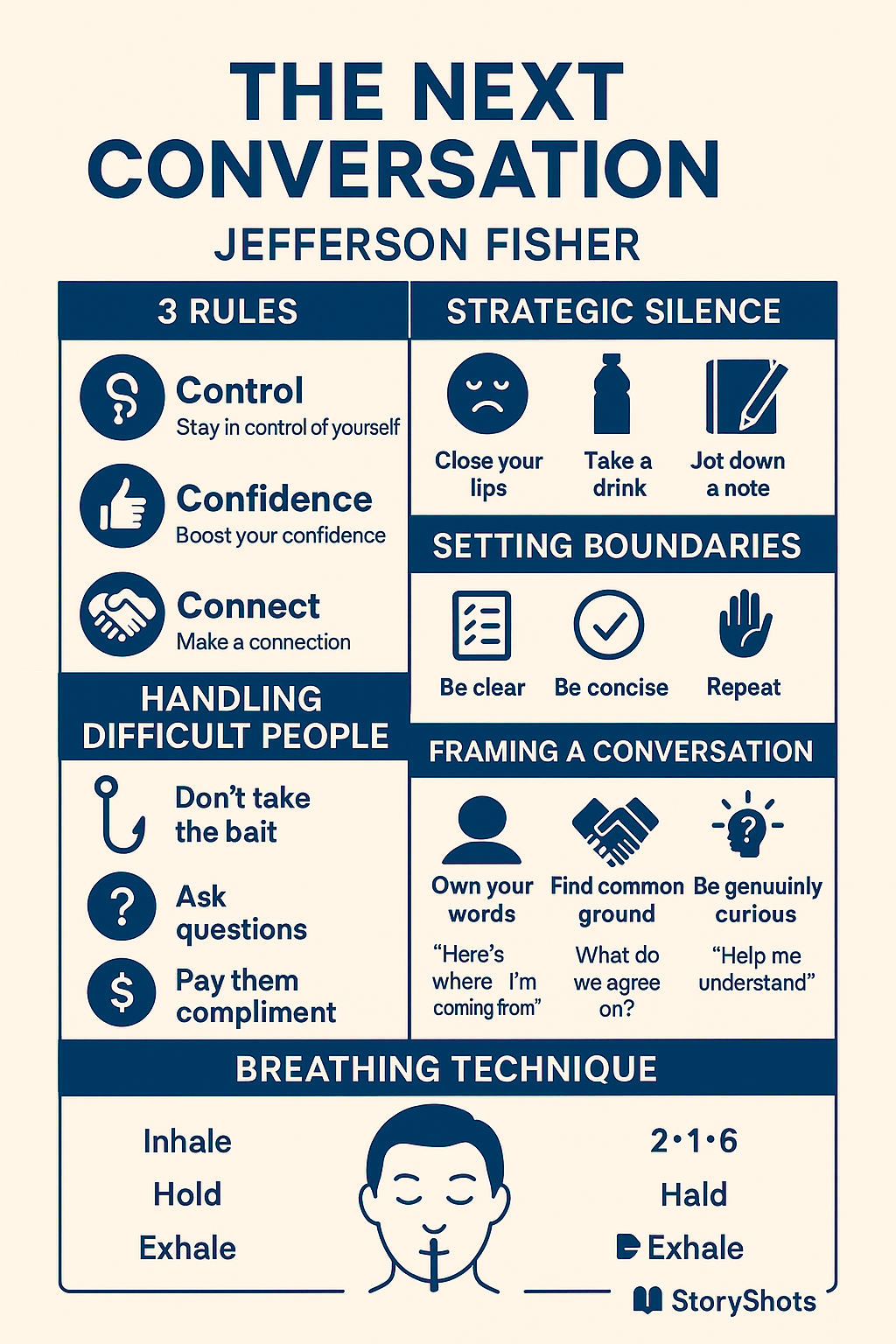
Fisher’s entire system has three simple rules: Say it with control, say it with confidence, and say it to connect. Master these three and you can handle any tough conversation better.
Rule 1: Say it with Control means managing your emotions. Before you can change a conversation, you must control your own reactions.
Rule 2: Say it with Confidence means speaking up for your needs clearly without being mean. This builds real confidence through action.
Rule 3: Say it to Connect means making sure you understand each other. You want real connection, especially in sensitive talks.
This system turns tough conversations from disasters into chances for stronger relationships.
StoryShot #4: Control Yourself First
Understanding what happens in your body during fights helps you stay in control. Fisher explains arguments have two phases. There’s ignition (fight-or-flight) and cooling (rest-and-digest). During ignition, your brain signals danger. Stress hormones release. Clear thinking stops.
Fisher gives three tools for those critical moments:
Tool 1: Special Breathing. Breathe in through your nose (2 seconds). Take another quick breath (1 second). Breathe out slowly (6 seconds). This calms your nervous system.
Tool 2: Body Check. Check your body for tension. Name your main emotion. Say internally, “I can tell I’m getting upset.”
Tool 3: Helpful Self-Talk. Create a short phrase that centers you. Examples: “Seek to understand,” “Stay strong,” or recall good advice.
StoryShot #5: Use Strategic Silence
“Silence is one of the hardest arguments to beat.” — Josh Billings
When people get anxious during fights, they talk faster and interrupt more. This leads to stumbling over words and misunderstandings.
Fisher uses two types of pauses:
Short pauses (1-4 seconds) add emphasis to important words. They show you’re thoughtful and in control.
Long pauses (5-10 seconds) make the other person think about what they just said. These work great with rude or dishonest people. The silence makes them uncomfortable and they often correct themselves.
Strategic silence isn’t weakness. It’s powerful. Rushing shows anxiety. Slowing down shows confidence.
StoryShot #6: Build Confidence Through Action
You can’t just decide to feel confident. Confidence comes from taking action. Fisher gives key lessons:
- Every word matters: Remove weak words like “just” and “sort of”
- Express needs clearly: Start sentences with “I need”
- Say less: Fewer words create stronger messages
- Remove filler words: Replace “ums” with silence
- Don’t put yourself down: Avoid “This might sound stupid”
- Declare confidence: Start with “I’m confident” when talking about your abilities
Tone matters: Sound balanced and controlled. Speak clearly at a steady pace.
StoryShot #7: Handle Difficult People Well
“Be curious. Curiosity might lead you somewhere new.” — Jeanette Winterson
Difficult people want emotional reactions. Don’t give them that. Fisher provides tactics for common bad behaviors:
For insults: Use a long pause. Slowly repeat what they said. Keep breathing. This makes their words echo and they reconsider.
For talking down to you: Make them repeat it (“Say that again”) or ask about intent (“Did you want to hurt me?”).
For being rude: Ask about intent (“Did you mean to sound rude?”) and wait for their answer.
For interrupting: Let them interrupt once. Use their name to get attention. Then correct them: “I can’t hear you when you interrupt. Let me finish.”
Key rule: Stand firm but be respectful. How you respond sets the standard for how others treat you.
StoryShot #8: Set Healthy Boundaries
Many people can’t say “no” because they learned to put others’ comfort first. This leads to being overwhelmed, angry, and hurt relationships. Fisher gives a clear way to set boundaries:
How to Say No Well
- Say no clearly first (“I can’t,” “I need to say no”) without long explanations
- Show thanks (“Thanks for thinking of me”) to keep the relationship good
- End kindly (“Hope it goes well!”) to stay connected
Making Boundaries Stick
- Start with the boundary: “I don’t accept how you’re treating me”
- Add consequences: “If you keep doing [behavior], I will [specific action]”
- Follow through: Only state consequences you’ll actually do
Some people will resist your new boundaries, especially if they benefited from your old ones. This discomfort means the boundary is working.
StoryShot #9: Frame Conversations Clearly
Like a picture frame sets borders, conversation framing keeps talks focused and on track.
How to Frame Any Tough Talk
- Set clear direction: State the topic (“I want to discuss yesterday’s feedback”)
- Explain the goal: Share what you want (“I want us to work better together”)
- Get agreement: Ask if they’re okay with this (“Sound good?”)
One topic rule: Focus on one issue per conversation. This keeps things clear and respects everyone’s time.
Stay on track: If you get off topic, apologize and return. If they get off topic, acknowledge briefly then redirect: “I hear you. Let me finish what we started.”
Some conversations are especially hard—giving bad news, discussing sensitive topics, or solving big conflicts.
Three Rules for Hard Conversations
Rule 1: Set aside real time. Pick a private, comfortable place where nobody feels rushed.
Rule 2: Skip small talk. When giving hard news, trying to “soften it” with chat can feel fake and increase worry. Be direct: “This will be hard to hear.”
Rule 3: Start with your main point. Lead with your key message instead of building up to it. This keeps the listener focused.
When Others Come to You
- Welcome them: “I’m glad you came to me”
- Ask one open question: “How are you feeling about that?”
- Ask before sharing: “Can I share something?”
- Offer experience, not orders: “Can I tell you what I’ve learned?”
Remember: Hard conversations are great chances to deepen connections when handled well.
Final Summary and Review
Jefferson Fisher’s “The Next Conversation: Argue Less, Talk More” turns communication from stressful to powerful. This isn’t just another self-help book. It’s a practical guide for anyone wanting to master tough conversations and build stronger relationships.
Why This Guide Works
Fisher’s lawyer background gives him real credibility. He’s not just talking theory—he’s handled tough conversations daily in high-pressure courtrooms. This experience gives you techniques that work when it matters.
The book’s best feature is how practical it is. You can use every strategy today. Fisher doesn’t ask you to change who you are. He shows you how to change your approach with his simple three-part system.
Key Takeaways
Master Fisher’s approach and transform any tough conversation:
- Arguments show struggles, not bad character. Difficult people are showing their pain through behavior.
- Your next conversation has more power than your last. Set realistic goals focused on learning, not winning.
- Control yourself first. Use breathing and positive self-talk to stay calm.
- Confidence grows through action. Build real confidence by practicing assertive communication.
- Strategic silence beats reactive speech. Well-timed pauses create space for thinking.
Our rating: 4.5/5 stars
“The Next Conversation” gets our highest recommendation for improving relationships, reducing conflicts, and communicating with confidence. This book turns one of life’s hardest skills into a learnable system.
What will you do with this knowledge? Which relationship could benefit from these techniques? Leave us a comment and join the conversation.
The Next Conversation Cheat Sheet Quick Reference Guide and Infographic
Download the cheat sheet here.
FAQ
Q: What is Jefferson Fisher’s 3-step system?
A: Three rules: Say it with control (manage emotions), say it with confidence (speak assertively), and say it to connect (ensure understanding). This helps turn tough conversations into relationship-building opportunities.
Q: How do I handle difficult conversations at work?
A: Frame the conversation clearly, use strategic pauses, stay emotionally controlled through breathing, and focus on understanding rather than winning. Set boundaries firmly but respectfully.
Q: What’s the best way to deal with difficult people?
A: Don’t give them the emotional reaction they want. Use strategic silence, ask about their intent when they’re rude, and stand your ground respectfully. Remember their difficult behavior often reflects personal struggles.
Q: How do I say no without hurting relationships?
A: Three steps: say no clearly first, show gratitude for being asked, and end with kindness. Don’t over-explain or apologize for having boundaries.
Q: What are the most important communication skills?
A: Emotional self-control, strategic use of silence, assertive communication, active listening, and the ability to frame conversations clearly.
Related Book Summaries
- Crucial Conversations
Kerry Patterson’s guide to high-stakes discussions—perfect with Fisher’s practical approach. - Difficult Conversations
Douglas Stone’s essential guide to tough talks with grace and effectiveness. - Emotional Intelligence
Daniel Goleman’s work on understanding emotions provides the foundation for Fisher’s techniques. - How to Talk to Anyone
Leil Lowndes gives 92 techniques for building instant rapport with anyone. - Surrounded by Idiots
- How to Win Friends and Influence People
The Next Conversation PDF, Free Audiobook, Infographic and Animated Book Summary
Comment below or share to show you care.
New to StoryShots? Get our free top-ranking app to access the PDF, audiobook and animated versions of this summary of The Next Conversation and hundreds of other bestselling nonfiction books. It’s been featured by Apple, The Guardian, The UN, and Google as one of the world’s best reading and learning apps.
This was the tip of the iceberg. To dive into the details and support Jefferson Fisher, order The Next Conversation here or get the audiobook for free.


 EN
EN  PT
PT  ES
ES  JA
JA  DE
DE  FR
FR  TR
TR  IT
IT  AR
AR  PL
PL  UK
UK  SV
SV  NL
NL  KO
KO